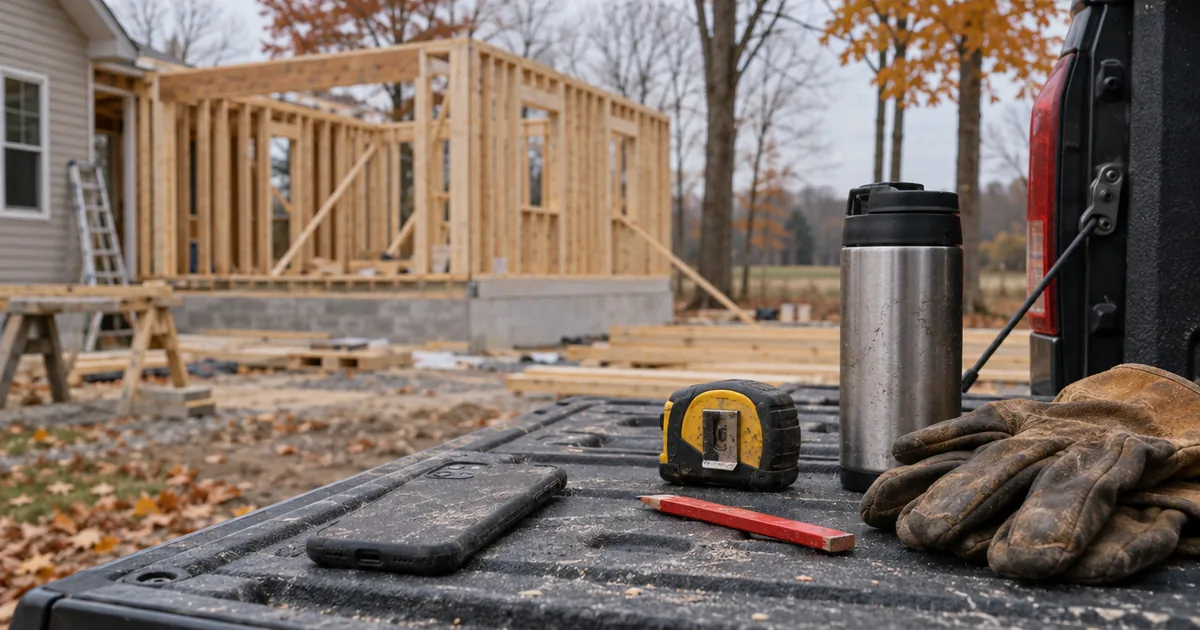
It's a Thursday in late October outside Carson City. A remodeler is framing a bump-out on a farmhouse kitchen. His phone sits face down on the tailgate next to his tape and his coffee. It rings at 9:12, at 10:40 and again right after lunch. He hears it over the saw every time and keeps cutting. That night he sits in the truck and listens to two voicemails. One caller wants a deck quote. The other just says "call me back" and leaves no name. This is the gap an AI answering service for contractors is meant to fill. It only fills it well if you set it up the way you would break in a new office hire.
I'm Kevin Nash. I run AutomAI out of Fenwick, and I build phone answering setups for small shops around here. I also work nights, so I know what it's like when the phone rings at the one hour you can't pick it up. Here is how I'd set one up for a one-truck or two-truck outfit.
Most contractors are their own front office
The U.S. Bureau of Labor Statistics counts about 889,700 carpenter jobs in 2025, and it lists self-employed workers as 25% of them. You can see both figures on the BLS carpenters page. The same page says self-employed carpenters have to bid new jobs, track stock and direct workers on top of the building itself.
So a lot of the people building decks, kitchens and pole barns in this part of the state are also the person answering the phone. They pick up between cuts or call back from the truck at dusk. When the work is heavy, the calls are the first thing to slip.
What an AI answering service for contractors does on a call
Think of it as a front desk that never steps away. It picks up on the first or second ring. It talks with the caller in plain language and asks the questions you'd ask. Then it sends you a short written summary.
A good summary for a contractor looks something like this:
- Name and callback number
- Town and road
- What they want built, fixed or replaced
- When they hope to start
- Whether they own the place
- Anything urgent, like a sagging beam or water coming in
You read that in the truck in thirty seconds. Compare it to a voicemail that says "hey, call me" with wind noise in the background.
Train it like you'd train a new hire
Picture hiring a sharp kid to run your office. You wouldn't hand them the phone on day one and walk out to the site. You'd sit them down for an hour and tell them how you run the business. Do the same here. These are the things I ask every contractor to write down before we turn anything on.
Your towns
List the towns and townships you'll drive to. If you stop at Stanton to the north and Ionia to the south, say so. The service can tell a caller in Big Rapids, kindly and right away, that you don't cover them. That saves both of you a callback.
Your work, and the work you pass on
Write out the jobs you want and the ones you don't. Maybe you love additions and won't touch a single window swap. Maybe you skip commercial bids. The clearer this list is, the fewer dead-end leads land in your summary.
What it never promises
It should never quote a job, promise a start date or say you're licensed for something you aren't. Its job is to collect the facts and set the next step. You stay the one who walks the site and writes the number.
Your one urgent line
Pick the few calls that can't wait for your evening callbacks. For most remodelers that list is short. Active water coming through a roof. A wall or beam that looks ready to give. A past customer whose job you just finished with a problem. Tell it what to do with those. Maybe that means a text to your phone right away, or a transfer to your foreman.
Trim your process first
Before you set up anything, look at what happens after a call today. A lot of shops have extra steps nobody needs. Maybe the caller gets asked for their address twice. Maybe you write leads on a scrap of paper, then type them into a notebook app, then copy them into a calendar.
Drop the steps that add nothing. Then give the service the short version. A machine running a messy process only makes the mess faster.
Check its work for two weeks
For the first two weeks, read every call summary the day it shows up. You're checking three things.
- Did it ask what you would have asked?
- Did it send anyone away who you'd have wanted?
- Did it miss anything urgent?
Each time you spot a miss, fix the instructions that day. Most setups need a few rounds of tuning before they sound like your shop. After that you'll skim them the way you skim a supplier invoice.
Your part of the call
You still do the talking that matters. People who hire a contractor want to meet the person who'll be in their house. The service makes sure the first call gets answered and the facts land in one place. You still make the callback. You just make it with the whole story in front of you, at a time that works for you.
It also helps on the days you aren't on a roof. Saturday afternoons, holiday weekends and the hour you're at your kid's game all count as missed-call time too. The service answers those the same way it answers a Tuesday at noon.
Test it like a customer would
Don't take anyone's word for how one of these sounds. Call it yourself. Pretend you're a homeowner in Sheridan with a rotted porch. Then call back as somebody two counties away who wants a pole barn. Listen to how it handles each one. If it sounds stiff or asks questions in a strange order, that's a setup problem you can fix before a real customer ever hears it.
Hear it for yourself
You can call our demo line right now at 989-467-3899 and talk to one. Pretend you're a customer and throw it a hard question. If you want to see how it would work for your crew, read more about our AI receptionist for Michigan businesses or send me a note. I'll walk through your towns, your jobs and your urgent calls with you before anything goes live.
Sources
- U.S. Bureau of Labor Statistics, Occupational Outlook Handbook, "Carpenters." https://www.bls.gov/ooh/construction-and-extraction/carpenters.htm