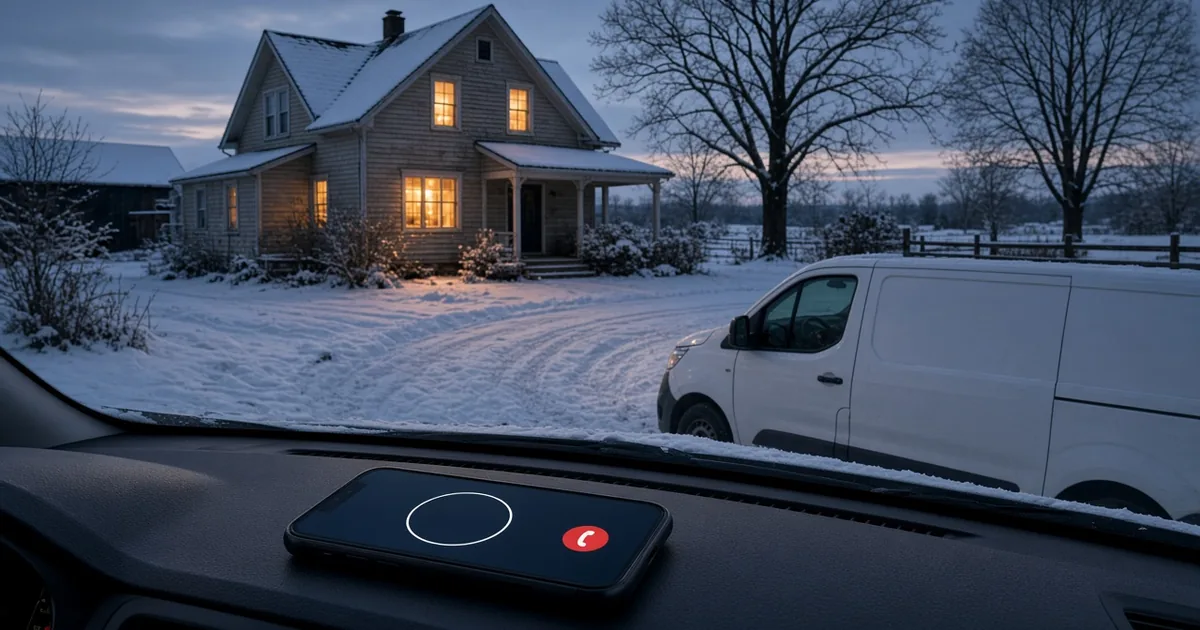
It is the first cold Saturday in November. A homeowner outside Greenville turns the thermostat up, hears the furnace click, and gets nothing. She calls the HVAC company on her fridge magnet. It rings six times and goes to voicemail. She hangs up and calls the next company in her search results. They answer, and they get the job.
Your tech was under a house in Belding when that call came in. Nobody did anything wrong. The phone simply had no one on it.
I'm Kevin Nash. I run AutomAI Innovations out of Fenwick and set up phone answering for service businesses around Greenville, Ionia and Montcalm County. This post covers what an AI receptionist for HVAC companies actually does, where it fits in a small shop, and how to test one before you trust it with your phones.
Why HVAC calls are different
A lot of HVAC calls are urgent, and the caller is shopping. A homeowner with no heat in January will call companies one after another until a person or a booking happens. The first company that gives them a time usually wins.
That pattern is backed by research on how quickly leads go cold. Harvard Business Review reported on a study of 1.25 million sales leads. Companies that tried to reach a lead within an hour were nearly seven times as likely to qualify it as companies that waited even one more hour. They were more than 60 times as likely as companies that waited 24 hours or longer.
That study looked at online leads. A call from a cold house is even more urgent. A caller with a cold house is not going to wait until Monday for your callback.
What an AI receptionist does on an HVAC call
An AI receptionist answers your business line in a natural voice when you can't. Here is what a typical call looks like for a heating and cooling shop.
- It answers on the first or second ring, day or night, with your company name.
- It asks what is going on. No heat, no cooling, a strange noise, a maintenance visit or a quote for a new system.
- It collects the name, address, callback number and the equipment details the caller knows.
- It sorts the call. A no-heat call with small kids or elderly people in the home gets flagged as urgent and sent to the on-call tech right away. A tune-up request goes on the schedule.
- It sends you a text summary so you can see every call at a glance.
- If the caller hangs up early, a text goes out to them within a minute so the lead does not disappear.
It works from rules you set. You decide what counts as an emergency, what your service area is, what hours you dispatch and what it should never promise. It does not quote repair prices unless you tell it exactly what to say.
Where it fits in a small shop
Plenty of HVAC companies in mid-Michigan are small. The owner often runs calls, does estimates and still answers the phone. A full-time office person costs a salary plus taxes, and still goes home at five.
An AI receptionist covers the gaps people can't.
- After hours and weekends. Furnaces fail at night. That is when most small shops have nobody answering.
- Busy mornings. The first hard freeze can bring a pile of calls before 9 a.m. Every line can be answered at once.
- When the office person is on another call. The second and third callers no longer hit voicemail.
- Lunch, sick days and vacations. Coverage does not depend on one person being at the desk.
Your best dispatcher still runs the board. The AI receptionist picks up the calls that would have gone to voicemail and gets them to your team with the details already written down.
What to check before you trust one
Quality varies a lot between setups. Before you put one on your main line, test these things yourself.
- Does it sound like a person you would hire? Call it at 11 p.m. and pretend your furnace is out. If it sounds robotic or confused, your customers will hang up.
- Does it know your service area? Ask about a town you do not cover. It should say so politely and still take the details if you want them.
- Does it handle emergencies the way you would? Mention a gas smell. It should tell the caller to leave the house and call the gas company or 911 first. That instruction should be written by you.
- Do you get the summary fast? A text should land on your phone within a minute or two of the call ending.
- Can you change the rules yourself? Your hours, prices and policies change. Updates should take minutes.
- Is it clear what you pay? Watch for long contracts and per-minute charges you cannot predict.
A simple test for your own shop
Pick one week this winter. Write down every call that went to voicemail and every voicemail nobody returned the same day. Then ask yourself how many of those were no-heat calls and what an average one of those jobs is worth to you.
You do not need an exact number. If one or two of those lost jobs are worth more than a month of coverage, the math is done.
You can also check how fast your shop calls back. Harvard Business Review audited 2,241 U.S. companies and found the average response time was 42 hours among companies that responded at all. Twenty-three percent never responded. If your callbacks run that slow, a homeowner with a cold house has already hired someone else.
Common questions
Will customers know they are talking to an AI?
Some will and some won't. What matters more is whether the call goes well. A clear, polite answer on the second ring beats voicemail every time. You can choose to have it say up front that it is an automated assistant.
What happens with real emergencies?
You set the rules. Most shops have urgent calls forwarded or texted straight to the on-call tech, with the address and problem already captured.
Does it work with my scheduling software?
Often yes, depending on what you use. At minimum it can text or email you every booking request so nothing gets lost.
How long does setup take?
A basic setup for a small HVAC shop usually takes a few days. That includes writing the call rules with you and testing it with real calls before it goes live.
Hear it for yourself
The quickest way to judge an AI receptionist is to call one. Call our demo line at 989-467-3899 and act like a homeowner with no heat. Then read how the AI receptionist service for Michigan businesses works, or reach out to Kevin to talk about your shop.
Sources
- James B. Oldroyd, Kristina McElheran and David Elkington, "The Short Life of Online Sales Leads," Harvard Business Review, March 2011. https://hbr.org/2011/03/the-short-life-of-online-sales-leads