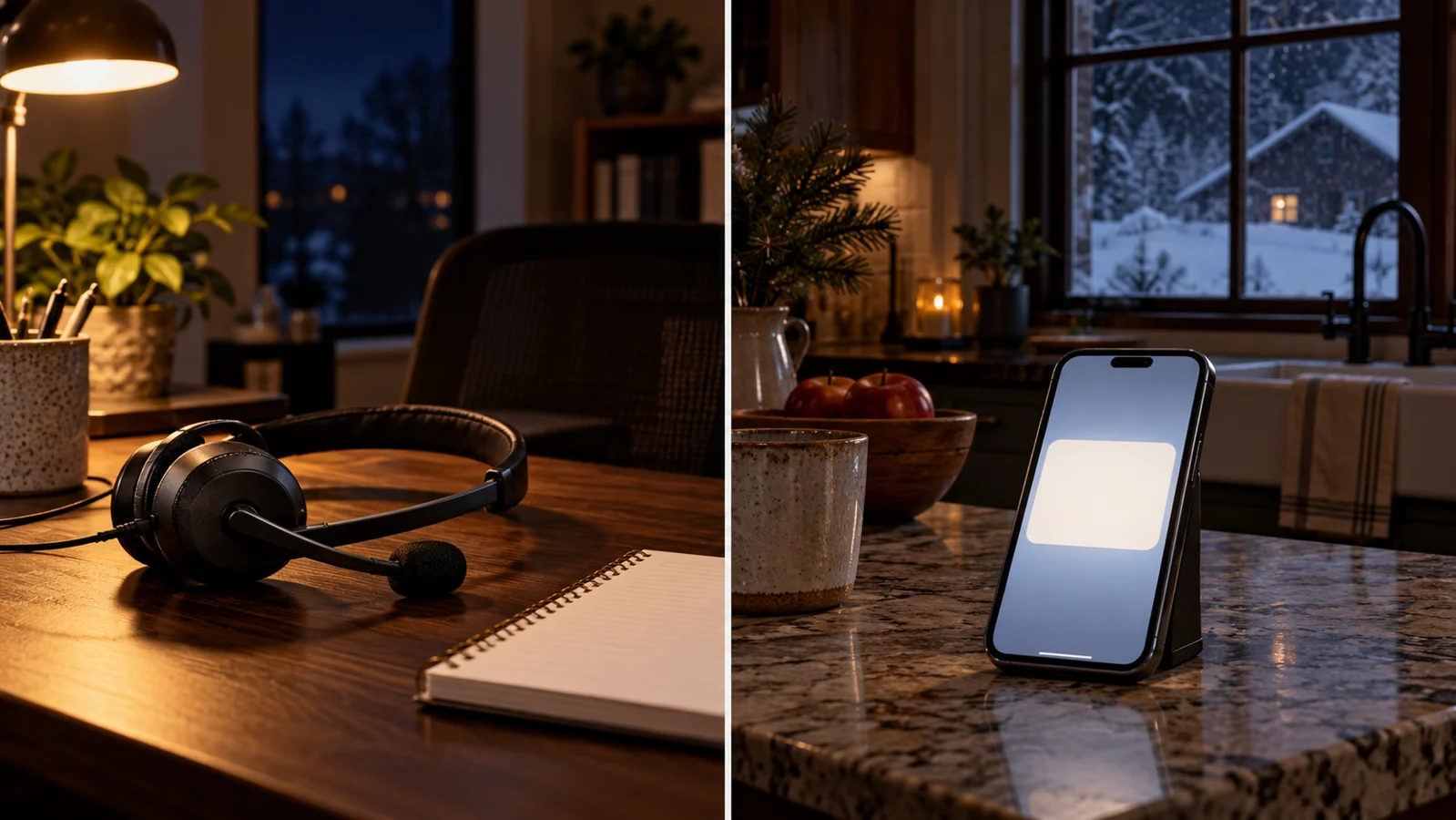
When a furnace quits at 9 p.m. in January, the homeowner calls the first company that looks able to help. If nobody answers, they call the next one. Most small service businesses in Michigan know they need someone or something on the phone after hours. The harder question is which kind.
The two common choices are a human answering service and an AI receptionist. Both have real strengths and real limits, and this guide lays them out so you can decide what suits your business.
Why the choice matters
Response speed matters for online sales leads. Harvard Business Review reported on a study of 1.25 million sales leads. Companies that made contact inside the first hour were nearly seven times as likely to have a real conversation with a decision maker as companies that tried an hour later. Those were online leads in 2011. The study does not establish the same effect for phone calls to contractors.
Many calls never reach anyone. In a 2016 study, the marketing firm 411 Locals tracked calls to 85 small businesses for 30 days. Only 37.8 percent were answered by a person. The sample was small and the firm sells marketing services, so read it as a rough guide.
What a human answering service does well
A live answering service puts a trained person on your line. For many businesses, that is the right answer.
People handle the unexpected
A caller who is upset, confused or describing an odd problem gets a human response. Operators can calm someone down and use judgment that no script fully covers.
Callers know they reached a person
Some customers, especially older ones, want to speak with a human and may hang up on anything that sounds automated. A live voice removes that worry.
Emergency escalation is familiar
Most services can follow an on-call list and phone you or a technician when a call meets your emergency rules. This setup has been around for decades and is well understood.
Little to build
Setup is usually a short form and a call script. You forward your line and the service starts.
Where a human answering service falls short
Operators often cover many companies at once. They read from your script, but they rarely know your trade, your service area or your schedule in detail. Many can only take a message, so the customer still waits for a callback before anything is booked.
Quality can vary from one operator to the next and from one shift to the next. Busy nights, such as the first cold snap of the year, can mean hold times. Billing is often tied to minutes or calls, which can climb in your busiest season.
What an AI receptionist does well
An AI receptionist is a voice system that answers your business line in plain language. A well-built one has several strengths.
It can handle overlapping calls
It can cover nights, weekends and holidays. Call capacity depends on the plan, setup and service availability.
It uses a consistent call flow
You choose the questions and details it should collect, then test the flow. It can collect the caller's name, number, address and problem, and send you a written summary.
It can do more than take a message
Depending on how it is set up, it can answer approved questions about hours and service area, book into a supported calendar, and enter the details into your customer records.
It can pass the call to a person
A good setup transfers a caller to you or your on-call technician when the rules say so.
Where an AI receptionist falls short
These limits are real, and any honest provider should tell you about them.
It is only as good as its setup
The call flow has to be written, tested and adjusted. A rushed setup will give wrong answers or ask clumsy questions. Plan on testing with sample calls before customers hear it, and on reviewing calls after launch.
Some callers dislike it
A share of callers will not want to talk to an automated system. A clear option to reach a person helps, though it will not win over everyone.
It can misunderstand
Poor cell signal, heavy accents, background noise and unusual requests can trip it up. It should be told to hand off whenever it is unsure, and never to guess at prices, diagnoses or promises.
It needs a human behind it
Emergencies, complaints and anything touching safety should go to a person. An AI receptionist supports the owner and should never stand in for the owner's judgment.
How to choose
A human answering service may suit you if your callers are mostly older, if most after-hours calls are emotional or complicated, or if you want something running this week with almost no setup.
An AI receptionist may suit you if you get many routine calls, want them booked or logged rather than turned into messages, or want the same questions asked every time.
Many shops use both. The AI handles routine intake at all hours, and a person takes emergencies and anything unusual. Whatever you choose, call your own line after hours once a month and listen as a customer would.
How AutomAI approaches it
AutomAI Innovations is Kevin Nash in Fenwick, Michigan. Kevin sets up AI receptionists for Michigan businesses by writing the call flow with the owner, including what it must never say and when it hands off to a human. Each one is tested with sample calls before launch and adjusted afterward. At Ionia 24/7 Fitness, a local gym, he also set up automatic replies to the messages people send through Facebook. Current pricing and details are on the receptionist page. Results vary and are not guaranteed.
Frequently asked questions
Is an AI receptionist better than an answering service?
Neither is better for every business. An AI receptionist is consistent and can book work at any hour. A human service handles emotion and odd situations better. Many owners combine them.
Can an AI receptionist handle emergency calls?
It can recognize the signs you define and transfer the caller to an on-call person. It should not make emergency decisions by itself.
Will customers know they are talking to AI?
Some will notice, and some will not. If a caller asks, the agent answers honestly and can pass the call to a person.
Do I need a new phone number for either option?
Usually not. Both normally work by forwarding your existing number when you do not answer or after hours.
See which fits your shop
If you want help weighing the two for your own calls, book a free 30-minute call with Kevin. There is no obligation, and you will leave with a clear picture of how your calls are handled today.
Sources
- James B. Oldroyd, Kristina McElheran and David Elkington, "The Short Life of Online Sales Leads," Harvard Business Review, March 2011. https://hbr.org/2011/03/the-short-life-of-online-sales-leads
- 411 Locals, "Small Business Owners Don't Answer 62% Of Phone Calls," January 18, 2016. https://411locals.us/small-business-owners-dont-answer-62-of-phone-calls/