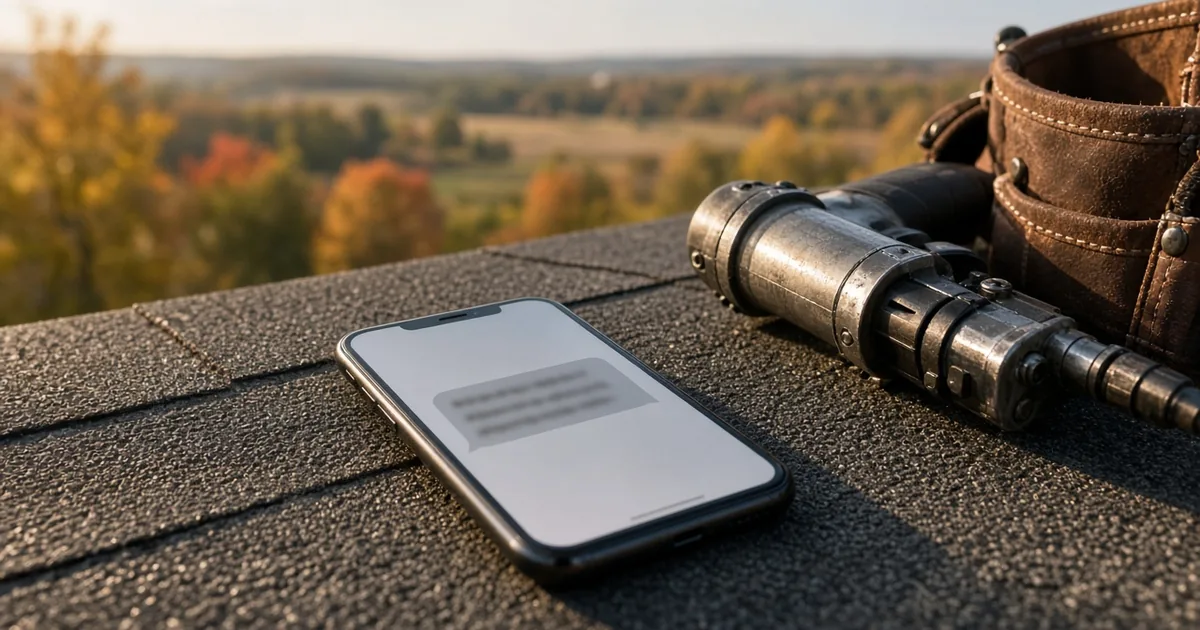
You are halfway up a roof in Stanton, and your phone buzzes. You can't answer. The caller doesn't leave a voicemail. By the time you get down, you have a number you don't recognize and no idea if it was a $200 repair or a full tear-off.
A missed call text back fixes a big part of that problem. It is one of the simplest tools a contractor can add, and I set it up for shops all over mid-Michigan. This post explains how it works, what the text should say, and the mistakes that make it backfire.
What a missed call text back is
When a call to your business number goes unanswered, the system sends the caller a text message within a few seconds. Something like this:
"Hi, this is Tom at Stanton Roofing. Sorry I missed your call, I'm on a job. What can I help you with? You can reply here and I'll get back to you today."
The caller now has a conversation started with you instead of a dead end. Many people would rather text than leave a voicemail anyway. They can reply with photos of the leak, their address, or a good time to call.
Why it works
Nearly everyone who calls you is holding a phone that can text. Pew Research Center reports that 91% of U.S. adults own a smartphone. A text reply lands on the same device the caller just used.
Speed matters even more. Harvard Business Review reported on a study of 1.25 million sales leads. Companies that tried to contact a lead within an hour were nearly seven times as likely to qualify it as those that waited longer. A text that goes out in ten seconds puts you inside that window even when you are on a ladder.
The same study's authors also audited 2,241 U.S. companies. Twenty-three percent never responded to leads at all. A homeowner calling three contractors will often go with the first one who answers in any form.
What contractors get out of it
- Fewer lost leads. Callers who would have hung up and moved on now have a reason to wait for you.
- Better information. People will text an address and a photo of the problem. That saves you a trip or a second call.
- Less phone tag. You can answer a text between jobs in 30 seconds. A callback can take 10 minutes.
- A record of every lead. Every missed call becomes a text thread you can scroll back through.
How to write the text
The message is short, but the wording matters. Follow these rules.
- Use your name and your company name. People trust a person more than a brand.
- Say why you missed the call. "I'm on a job" is honest and makes sense to anyone hiring a contractor.
- Ask one question. "What can I help you with?" works well.
- Give a time frame you can keep. "Today" or "within the hour" only if you can actually do it.
- Skip links and sales pitches in the first text. They make the message look like spam.
- Keep it under 160 characters if you can. Short texts read better on a phone screen.
Mistakes that make it backfire
Texting numbers that should not get a text. Your supplier, your kid's school and the bank do not need an automated message. Good systems let you exclude saved contacts.
Promising a callback you never make. A fast text followed by silence feels worse than voicemail. Someone has to own the replies every day.
Sending a wall of text. One friendly line beats a paragraph about your services.
Skipping the rules on business texting. Commercial text messages in the U.S. go through carrier registration, often called 10DLC. Your provider should handle it. If they don't mention it, ask. Unregistered texts can get blocked.
Using it as a replacement for answering. A text back catches the calls you miss. It works best alongside someone or something that answers live when it can.
Text back alone or with an AI receptionist?
A missed call text back is a good first step. It costs little and catches a lot. Its limit is that the caller still has to wait for you to reply.
An AI receptionist goes further. It answers the call live, asks the right questions, books or flags the job and sends you a summary. If the caller hangs up before it finishes, the text back still fires as a safety net.
For a one-truck shop, text back alone may be enough to start. For a busy season with several crews, live answering covers a lot more ground. The honest answer depends on how many calls you miss and what an average job is worth.
A quick way to see what you are missing
Look at your phone's call log for the last two weeks. Count every missed call from a number that is not in your contacts. Then count how many of those you called back the same day.
The first number shows how many leads are slipping. The gap between the two shows how much a text back would help.
Common questions
Will it text my personal calls?
Not if it is set up right. It should only run on your business line, and you can exclude saved contacts.
Does it work with my current phone?
Usually. Most setups work with unanswered calls on the business line you use today. Your phone carrier's options decide the details.
What if the caller texts back after hours?
You can reply in the morning, or pair it with an AI receptionist that answers texts and calls around the clock.
Hear it for yourself
Want to hear what a caller hears? Call our demo line at 989-467-3899. Then read about the AI receptionist service for Michigan businesses, which includes missed call text back, or contact Kevin to set it up for your shop.
Sources
- Pew Research Center, "Mobile Fact Sheet." https://www.pewresearch.org/internet/fact-sheet/mobile/
- James B. Oldroyd, Kristina McElheran and David Elkington, "The Short Life of Online Sales Leads," Harvard Business Review, March 2011. https://hbr.org/2011/03/the-short-life-of-online-sales-leads