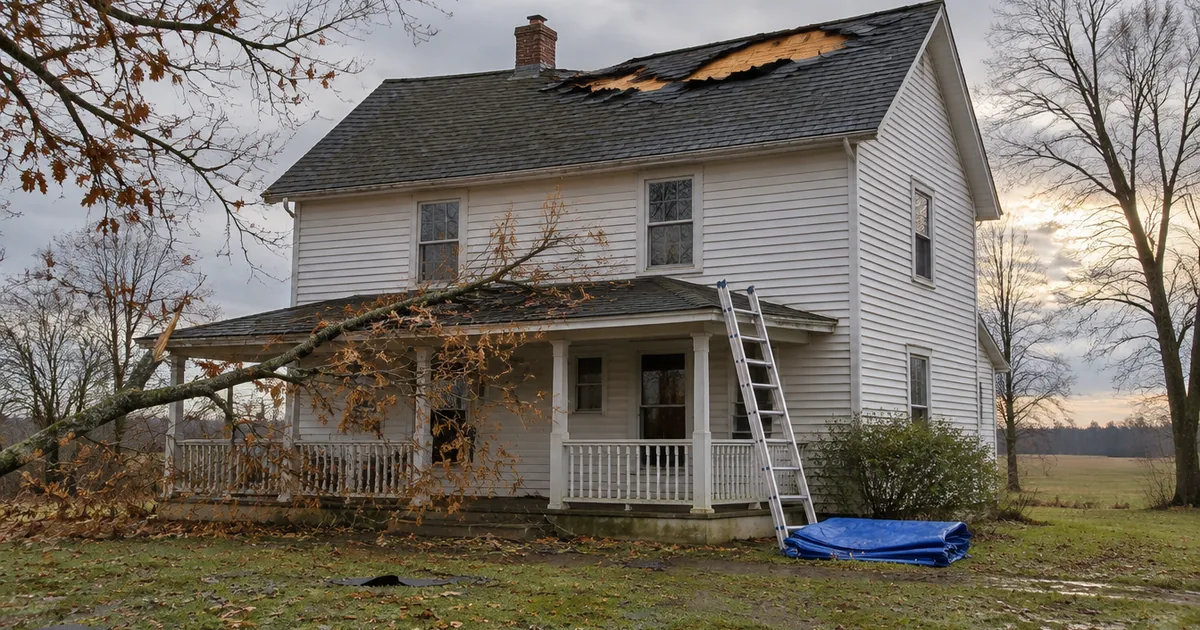
The wind comes through Montcalm County a little after supper on a Thursday. By morning there are shingles in the ditch along M-57 and a maple limb through somebody's porch roof outside Carson City. You've got one crew and a full schedule already. Your phone starts ringing at 6:40 and it doesn't stop. You take the first four calls from the truck. Then you're on a ladder, and the next nine go to voicemail. That's how missed calls at a Michigan roofing company really happen. They come in bunches, on the exact days the work is there to win. The storm brings the work. The phone decides who gets it.
I'm Kevin Nash. I run AutomAI Innovations out of Fenwick, and I set up phone answering for service shops around Greenville, Ionia and Carson City. I work nights, so I'm often awake when the wind hits. This post is about one thing: what happens to your phone the day after a storm, and how to plan for it before the next one.
Storm calls are a different kind of call
On a normal Tuesday, a roofing call is somebody planning ahead. They want a quote on a tear-off for next spring. They'll wait a day to hear back.
Storm calls aren't like that. The homeowner is standing in the kitchen looking at a brown spot on the ceiling. The insurance agent told them to get it looked at. They want a name and a time, and they want it today.
Storms aren't rare, either. NOAA's Storm Prediction Center counted 5,432 hail events in 2025, up from 5,373 in 2024, according to the Insurance Information Institute. Those are hailstones an inch across or bigger. Add wind, ice and heavy snow to that, and a Michigan roofer gets a few rush days most years.
What Michigan homeowners are told to do
After a big storm, the state tells homeowners how to shop for you.
In May 2025, Michigan Attorney General Dana Nessel put out a post-storm alert. Before signing anything, she told people to speak to a local, licensed professional and get more than one written estimate. In September 2026 she reissued her storm alerts after storms left hundreds of thousands without power across the state.
That's good advice for the homeowner. Think about what it does to your phone, though.
A homeowner with a leak is now calling more than one local roofer on purpose. They're building a short list. The roofers who answer get on it. The ones who go to voicemail are easy to skip.
On a storm morning, the first contest is who picks up. Price comes later.
Why voicemail fails on a storm day
The usual plan is to catch up at lunch. On a storm day, lunch doesn't come.
Picture going through your voicemail that night. Here's what you'll likely find:
- A lot of hang-ups with no message at all
- Messages with half a phone number because the caller was on a bad cell signal
- Three calls from the same house, each one a little more upset
- A leak call buried behind two calls asking about gutters
By the time you call back, the homeowner may have had two roofers out already. Maybe one was a door-knocker who promised to start today. The Attorney General warns people about that kind of pitch for a reason. Meanwhile the local roofer who'd do it right never got a word in.
A storm-day call plan for missed calls at a roofing company in Michigan
You can't add a crew overnight. You can decide right now how every call gets handled when the next storm hits. Write it on one page.
- Sort the calls. Active leak or a hole in the roof goes on one list. Damage with no water coming in goes on another. Quotes and gutters can wait a day.
- Pick the questions. Address, best callback number, what they see, whether water is coming in and whether they've called their insurance yet.
- Decide what gets said. Callers want to know when someone will come out. Give a callback window you can keep, like "by end of day." Don't promise a time you can't hit.
- Pick who hears about leaks right away. That might be you, your office person or your foreman. Write down one name.
- Say what you won't do. If you don't do emergency tarping, say so up front, so nobody waits on you for nothing.
That one page is worth having even if a person answers every call. A lot of shops keep it in the owner's head, and it's gone the minute the phone rings for the tenth time.
Who answers when the crew is on the roof
Somebody has to work that page. In a small shop, it's usually the owner. That means you're on a ladder with a phone in your pocket and it's buzzing nonstop.
Some shops bring in a spouse or a part-timer on storm days. That works if they're free and they know the questions. Some use an answering service, which takes a message and passes it along.
The other option is an AI receptionist set up for a Michigan business. When you can't pick up, it answers in your business name. It asks the questions you picked, collects the caller's name, number and what they need, and answers only the questions you've approved. It can book into a supported calendar or transfer a leak call to a person. After each call you get a text or email summary.
On a storm morning, that means the leak calls come to you sorted and ready. You call back the ceiling drip first. You don't have to dig through nine voicemails to find it.
You still make every call that matters. You decide which jobs you take, what you charge and when the crew rolls. The receptionist gets the homeowner's details down while they still want you.
Set it up before the next storm
The worst time to fix your phones is the morning the wind blows through. Do it on a slow week, like right now, before the ice and the heavy snow show up.
Take the one-page plan above and fill it in tonight. Then go back through last year and count the storm days. Pull up your call log for each one and count what went to voicemail. It's ten minutes of work, and it tells you whether storm calls are a real problem for your shop or a small one.
If your shop answered every one of those calls, keep doing what you're doing. If it didn't, you know what to fix before the next storm.
Hear it for yourself
Call 989-467-3899 and ask for a demo for a roofing company. Tell it a limb came through your porch roof last night and water is dripping by the door. Listen to what it asks and how it sorts the call. If you want one set up for your shop, send me a note on the contact page with how your calls come in today and what a storm morning looks like for you.
Sources
- Insurance Information Institute, "Facts + Statistics: Hail," citing NOAA's National Weather Service Storm Prediction Center. https://www.iii.org/fact-statistic/facts-statistics-hail
- Michigan Department of Attorney General, "AG Nessel Reissues Post-Storm Scams Alerts Following Severe Weather," May 16, 2025. https://www.michigan.gov/ag/news/press-releases/2025/05/16/ag-nessel-reissues-post-storm-scams-alerts-following-severe-weather
- Michigan Department of Attorney General, "AG Nessel Reissues Storm Alerts Following Severe Weather," September 4, 2026. https://www.michigan.gov/ag/news/press-releases/2026/09/04/ag-nessel-reissues-storm-alerts-following-severe-weather