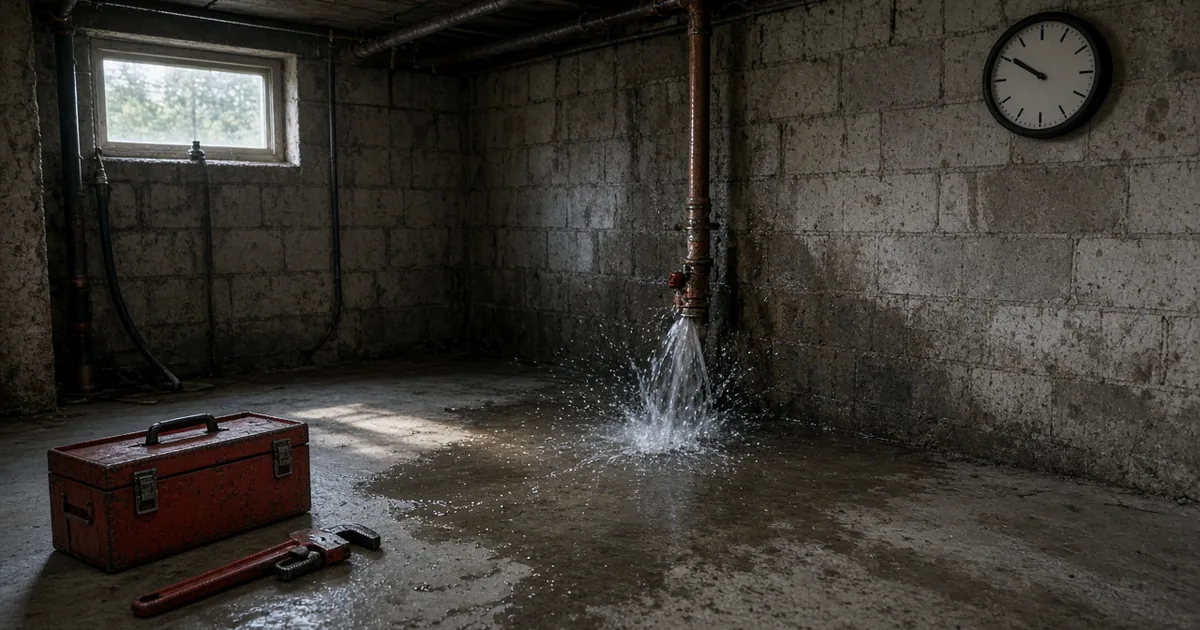
A pipe bursts in a basement in Ionia on a Tuesday morning. The homeowner finds three plumbers on her phone and calls the first one. Voicemail. She calls the second. Voicemail. The third one picks up and says he can be there by noon. The first two plumbers call her back that afternoon. She has already paid the third.
That is speed to lead in one story. The plumber who responds first usually gets the job, and the gap between first and second can be minutes.
I'm Kevin Nash, and I set up call answering for service businesses across mid-Michigan. This post covers what the research says about response time, what it means for a plumbing shop in mid-Michigan, and practical ways to answer faster without adding payroll.
What speed to lead means
Speed to lead is the time between a customer reaching out and your business responding. For plumbers, that usually means a phone call. It can also be a web form, a text or a message on your Google Business Profile.
The clock starts when they call. It stops when they talk to someone who can help them or book a time.
What the research says
The best-known study on this was published in Harvard Business Review in 2011. The researchers looked at 1.25 million sales leads across 42 companies. Firms that tried to contact a lead within an hour were nearly seven times as likely to qualify it as firms that waited even one more hour. They were more than 60 times as likely as firms that waited 24 hours or longer.
The same authors audited 2,241 U.S. companies to see how fast they actually responded. Thirty-seven percent responded within an hour. Twenty-three percent never responded at all. The average response time among companies that did respond was 42 hours.
That research covered online leads in many industries. Plumbing leads are usually more urgent. A homeowner with water on the floor is not waiting 42 hours. They are not waiting 42 minutes.
Why plumbers lose on speed
Most slow callbacks come down to busy hands.
- You are on a job. Under a sink or in a crawl space, you can't take a call.
- You are driving. Answering a call at 55 miles an hour on M-21 is not a good idea.
- The office person is on another call. One person can only handle one line at a time.
- It is after hours. Water heaters and sump pumps fail at night and on weekends.
Every one of those gaps sends a caller to voicemail. Plenty of people with water on the floor will not leave one. They will call the next name on the list.
How fast is fast enough
Based on the research, the goal for a plumbing company should be simple.
- Emergency calls. Answered live, or responded to within five minutes.
- Non-urgent service calls. Responded to within the hour.
- Quote requests and web forms. Responded to the same business day, and within an hour when you can.
If you hit those numbers, you are in good shape. If you are not sure, the next section will tell you.
How to measure your own speed
You do not need software to find out where you stand. Try this for two weeks.
- Write down every missed call from a number not in your contacts.
- Note the time of the missed call and the time you called back.
- Mark whether you got the job.
At the end of two weeks, compare the jobs you won with the jobs you lost. Look at how fast you called back on each. That pattern is your real speed to lead.
Ways to respond faster without hiring
You do not need to add a full-time office person to answer faster. Here are options from simplest to most complete.
Missed call text back. When you miss a call, the caller gets a text within seconds. It says who you are and asks what they need. It keeps the lead warm until you can call.
A shared callback rule. Decide who in your shop returns missed calls and how fast. Write it down. Simple rules get followed.
An answering service. A live person answers your phone and takes a message. It helps, though many services cannot book jobs or judge what counts as an emergency for your shop.
An AI receptionist. It answers every call on the first ring, day or night. It asks what the problem is, gets the address and contact details, flags emergencies to your on-call plumber and books routine work. You get a text summary of every call. Several calls at once are no problem.
For most small plumbing shops in mid-Michigan, a missed call text back plus an AI receptionist covers almost every gap.
What to say when you do call back
Speed gets you the conversation. What you say next gets you the job.
- Use their name and mention the problem they called about.
- Give a real time window. "Between 1 and 3 today" beats "sometime this afternoon."
- Explain your service call fee up front so there are no surprises.
- Confirm the address and the best number to reach them.
Common questions
Is the Harvard study still relevant?
It is from 2011, and phones have changed a lot since then. Customers expect faster answers now, so the core finding still holds up.
Do customers mind talking to an AI receptionist?
Most care about getting help quickly. A clear, polite answer that books a time beats voicemail. You can decide whether it introduces itself as an automated assistant.
What does it cost to answer faster?
It depends on the setup. A text back costs little. An AI receptionist costs more but covers live answering. Compare it with the value of one lost job a month.
Hear it for yourself
The best test is a real call. Call our demo line at 989-467-3899 and describe a burst pipe. Then read how the AI receptionist service for Michigan businesses works, or contact Kevin to talk about your shop.
Sources
- James B. Oldroyd, Kristina McElheran and David Elkington, "The Short Life of Online Sales Leads," Harvard Business Review, March 2011. https://hbr.org/2011/03/the-short-life-of-online-sales-leads